Unpacking the Unspoken: How Content & Work Analysis Reveals Communication Patterns and Deeper Meanings
Every email, every report, every customer review, and every meeting transcript holds a universe of information far beyond its literal words. It’s a tapestry woven with intentions, emotions, unspoken assumptions, and evolving trends. But how do you systematically unravel these threads to truly understand what's being communicated, and what impact that has on your work, your team, or your entire organization? This is precisely where Content & Work Analysis shines, transforming raw communication into actionable intelligence.
It's more than just reading; it's a rigorous, insightful method for decoding the very fabric of human interaction, especially within professional settings. Imagine being able to objectively identify why a project is stalled, what customers really feel about your product, or how company culture shifts over time—all by systematically examining the everyday communications you already have.
At a Glance: What You’ll Discover
- Decipher Hidden Meanings: Learn how to move beyond surface-level text to uncover underlying themes, sentiment, and patterns in any communication.
- Bridge Qualitative & Quantitative: Understand how this method uniquely blends deep interpretive insights with measurable data.
- Explore Practical Applications: See real-world examples from marketing to HR, showing how content analysis fuels strategic decisions.
- Master the Core Process: Get a step-by-step guide to conducting your own reliable and valid content analysis.
- Navigate Challenges: Understand common pitfalls and how to ensure your analysis is robust and trustworthy.
Beyond the Surface: What is Content & Work Analysis, Really?
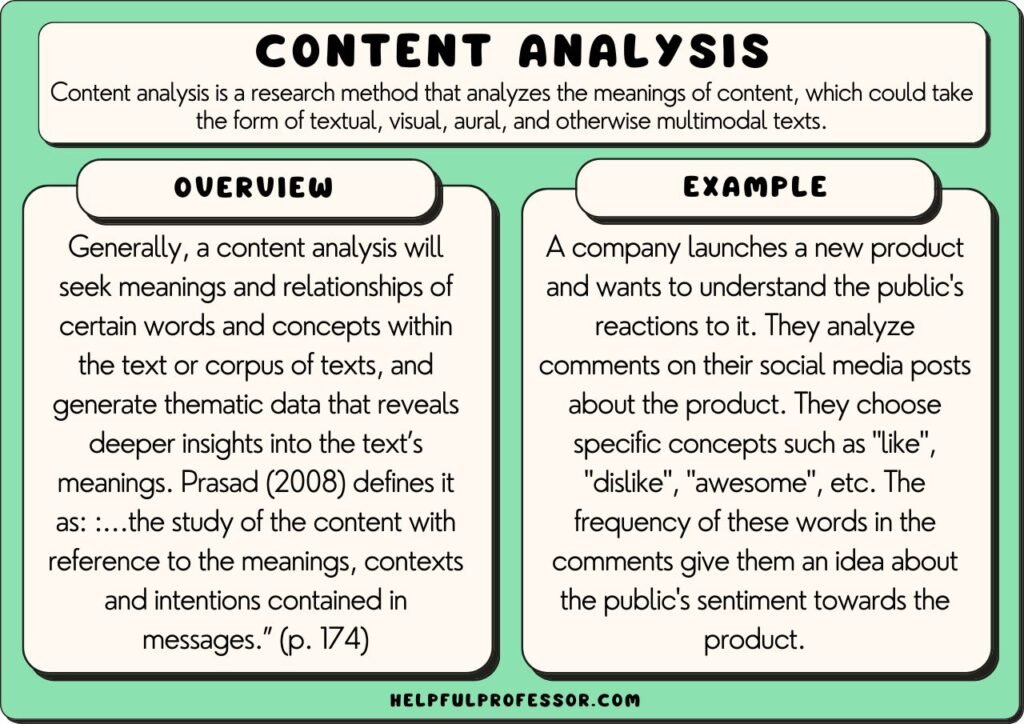
At its heart, content analysis is a research superpower. It's the systematic process of taking a vast sea of qualitative data—like text, audio, or video—and breaking it down into manageable, meaningful categories to make objective inferences. Think of it as putting on a special pair of glasses that allow you to see the invisible structures and forces at play within communication.
As Holsti (1968) famously put it, it's "any technique for making inferences by systematically and objectively identifying special characteristics of messages." Berelson (1952) honed this further, defining it as "a research technique for the objective, systematic, and quantitative description of the manifest content of communication." In simpler terms, it's about dissecting messages to understand their building blocks and how they fit together.
So, where does "Work Analysis" fit in? While the core methodology remains "content analysis," the "Work" aspect refers to its application within professional, organizational, and business contexts. This means applying these analytical techniques to workplace communications and data to understand:
- Organizational Dynamics: How teams communicate, decision-making patterns, and cultural norms.
- Customer & Market Insights: What customers say in reviews, support tickets, or surveys about products, services, and brands.
- Operational Efficiency: Analyzing project documentation, internal communications, or process descriptions to identify bottlenecks or areas for improvement.
- HR & Employee Engagement: Decoding employee feedback, performance reviews, or exit interviews to understand sentiment and identify areas for intervention.
In essence, Content & Work Analysis gives you a structured way to turn the chaotic flow of information in your professional life into clear, actionable insights.
Where Does the Data Come From? Your Communication Treasure Chest
One of the greatest strengths of content analysis is its incredible versatility in handling data. Chances are, you're already sitting on a goldmine of information ripe for analysis. Your "text" isn't just written words; it can be any form of recorded communication.
Consider these common sources:
- Interviews & Open-Ended Questions: The rich narratives from customer interviews, employee feedback sessions, or survey responses.
- Field Research Notes & Conversations: Detailed observations from ethnographic studies, sales calls, or client meetings.
- Written Materials: Books, essays, reports, internal policies, company manifestos, and historical documents.
- Media: Newspaper headlines, articles, speeches, social media posts, advertising campaigns, and even entire films or TV shows.
- Digital Communications: Emails, chat logs (Slack, Teams), forum discussions, and website content.
- Visuals & Audio (transcribed): Images, videos, podcasts, and voicemails, once converted into text or coded directly for visual/auditory elements.
The beauty here is that content analysis is largely unobtrusive; it often uses data that already exists, minimizing disruption and offering a naturalistic view of communication as it happens.
The Anatomy of Insight: How Content Analysis Works
At its core, content analysis involves a systematic journey from raw, unstructured data to organized, interpretable findings. It's a structured approach, but one that allows for deep exploration.
The Core Process: From Text to Meaning
- Breaking Down (Coding): You start by taking your chosen text (or transcribed audio/video) and breaking it into manageable "chunks." These chunks are then labeled with "codes"—short, descriptive tags that capture the essence of what's being communicated. For example, in customer reviews, a sentence like "The product arrived quickly but the packaging was damaged" might be coded as "delivery_speed_positive" and "packaging_condition_negative."
- Grouping (Categorization): As you apply codes, you'll notice certain codes are similar or related. You then group these into broader "code categories" or themes. Our previous example codes might fall under "Logistics & Delivery." This level of summarization helps you see the bigger picture.
- Interpreting (Analysis): With your data categorized, you can now analyze it. This might involve counting the frequency of codes or categories (quantitative) or deeply exploring the nuances and relationships between them (qualitative).
Key Features That Make It Powerful
- Systematic Approach: It's not arbitrary. You establish clear rules and definitions for your codes and categories upfront, ensuring consistency and replicability. This structured nature builds trust in your findings.
- Flexible Data Sources: As discussed, from tweets to historical treaties, if it communicates, it can be analyzed.
- Dual Purpose: Qualitative & Quantitative: This is a unique advantage. You can use it to understand what people are saying (qualitative themes) and how often they're saying it (quantitative frequency), often within the same study. For instance, you could identify recurring themes in employee feedback (qualitative) and then count how many employees mentioned each theme (quantitative).
What Insights Can You Gain?
The applications are incredibly broad, touching nearly every field where communication matters:
- Identify Intentions & Trends: Uncover the underlying goals or biases in political speeches, marketing messages, or internal memos. Spot shifts in communication patterns over time.
- Describe Attitudes & Behaviors: Gauge public opinion on a new policy, assess customer sentiment towards a brand, or analyze how employees react to a new company initiative.
- Determine Psychological & Emotional States: Analyze language in personal narratives, social media posts, or support interactions to infer emotional tones (e.g., frustration, satisfaction, anxiety). This is crucial for understanding user experience.
- Reveal Cultural Differences: Compare communication content across different regions or cultures to identify unique patterns, values, or expressions.
- Pre-test & Improve Interventions: Before launching a new training program or survey, analyze draft materials to ensure clarity, tone, and effectiveness.
- Monitor Change Over Time: Track how cultural norms, public opinion, or market behaviors evolve by regularly analyzing media or social discourse.
Across sociology, marketing, media studies, psychology, and health communication, content analysis provides the evidence-based lens needed to truly understand the complex world of communication. Understanding these communication patterns is a critical first step towards effective strategies.
Choosing Your Lens: Types of Content Analysis
While the core process remains, content analysis can be approached with different focuses depending on your research question. Let's explore the main types.
1. Conceptual Analysis: Counting Concepts
This is the most straightforward form, focusing on the existence and frequency of specific concepts (words, phrases, or ideas) within a text. It helps you answer questions like "How often is X mentioned?" or "Is Y present in this document?"
- Goal: To systematically examine the occurrence of selected terms, whether explicitly stated or implicitly implied.
- Implicit Terms: These are trickier. If you're looking for the concept of "safety" you might count "secure" or "protected" as well. This requires careful definition and consistent application of coding rules, often aided by dictionaries or context-specific guidelines.
Your General Steps for Conceptual Analysis:
- Define Your Research Question & Choose Samples: What specific concepts are you looking for, and in which texts? (e.g., "How frequently do product reviews mention 'durability' or 'value for money'?").
- Code Text into Manageable Categories: This is "selective reduction." You're deciding what parts of the text are relevant to your inquiry.
- Decide Level of Analysis: Will you count individual words, word senses, phrases, entire sentences, or broader themes?
- Decide Number of Concepts: Are you looking for a pre-defined list of terms, or will new concepts emerge during coding?
- Decide on Existence vs. Frequency: Do you just want to know if a concept is present (count once per document) or how many times it appears (count every occurrence)?
- Distinguish Concepts Clearly: How will you differentiate between similar terms or explicit vs. implicit meanings? (e.g., "dangerous" vs. "danger").
- Develop Clear Coding Rules: This is vital for consistency. Write down exact definitions for each concept and examples of what to include/exclude.
- Handle Irrelevant Information: Decide whether to ignore it, or if its presence/absence is itself a useful data point.
- Code the Text: This can be done manually (slower, but good for nuance and error spotting) or using software (faster for large datasets, but requires careful setup to avoid misinterpretations).
- Analyze Results & Interpret: Tally your counts, look for trends, compare frequencies across different texts, and draw conclusions relative to your research question. Re-examine any outliers or unexpected results.
2. Relational Analysis: Mapping Connections
Building on conceptual analysis, relational analysis goes a step further by examining the relationships between concepts. It asks not just "What's being said?" but "How are these concepts linked, and what does that imply?" The meaning often emerges from these connections.
- Goal: To understand how concepts interact and influence each other within a text.
Your General Steps for Relational Analysis:
- Identify a Focused Research Question & Choose Samples: What specific relationships are you exploring? (e.g., "What emotions are most strongly associated with discussions of 'product features' in customer feedback?").
- Select Text Carefully: Ensure your text is rich enough to show relationships without being overwhelmingly vast.
- Determine Type & Level of Analysis:
- Affect Extraction: Identifying the emotional tone (positive, negative, neutral) associated with specific concepts.
- Proximity Analysis: Measuring how often concepts appear together within a certain "window" of text (e.g., within the same sentence or paragraph) to create a "concept matrix" of co-occurrence.
- Cognitive Mapping: A visualization technique to graphically represent the relationships between concepts, their strength, and direction.
- Reduce Text & Code for Concepts/Patterns: Similar to conceptual analysis, but now you're also looking for cues that indicate relationships.
- Explore Relationships: Beyond just existence, determine the strength (strong/weak), sign (positive/negative), and direction (e.g., "X leads to Y" vs. "Y results from X") of the connections.
- Code the Relationships: This involves defining how you'll tag these connections during your coding process.
- Perform Statistical Analyses: Use statistical methods to quantify the strength and significance of observed relationships.
- Map Out Representations: Create visual models (like network diagrams or mind maps) to illustrate the intricate web of concept relationships.
3. Qualitative, Quantitative, & Summative: Different Strokes for Different Folks
These categories aren't mutually exclusive but rather describe the primary emphasis of your analysis:
- Qualitative Content Analysis: Focuses on rich interpretation. You delve deep into the text to understand underlying themes, nuanced meanings, and subtle patterns. It's about why and how things are communicated, often used for sentiment analysis of customer reviews or exploring narratives in interviews. This approach is often paired with other qualitative research methods.
- Quantitative Content Analysis: Emphasizes counting and measurement. You quantify the frequency of specific words, phrases, symbols, or categories. It's about what and how much, often used to track content trends (e.g., how often political candidates use certain keywords).
- Summative Content Analysis: A hybrid approach that starts with quantitative counting of keywords or content, then follows up with a qualitative interpretation of their context. For instance, you might count mentions of "sustainability" in corporate reports and then qualitatively analyze how "sustainability" is discussed to understand its specific meaning and emphasis.
Your Step-by-Step Guide to Conducting Content & Work Analysis
Ready to roll up your sleeves? Here's a practical framework to guide you through your own content analysis project, ensuring you move from raw data to robust insights.
1. Define Your Research Questions and Objectives
Before you analyze a single word, clarify what you want to learn. Your questions should be specific, measurable, achievable, relevant, and time-bound (SMART).
- Example: "What are the primary challenges new employees articulate in their first 90 days, based on anonymized onboarding survey responses?"
2. Select Appropriate Data Sources
Based on your research question, identify where the answers likely reside. Be strategic about your selection to ensure the data is relevant and representative.
- Example: For the new employee challenge question, survey responses from employees hired in the last year would be appropriate.
3. Develop a Coding Framework
This is your analytical blueprint. A coding framework consists of:
- Categories: Broad themes or topics you expect to find (or want to explore).
- Codes: More granular labels that you'll apply directly to segments of your text.
- Definitions: Clear, unambiguous explanations for each code and category, along with inclusion/exclusion criteria.
You can develop this framework deductively (based on existing theories or prior knowledge) or inductively (letting themes emerge directly from the data as you read). Often, it's a blend of both.
4. Code Your Data
This is where you systematically go through your text and apply the codes from your framework. Segment your data into meaningful units (e.g., a sentence, a paragraph, a whole document) and assign relevant codes.
- Tip: Consistency is key. If working with a team, ensure everyone understands and applies the codes in the same way. Software like NVivo, ATLAS.ti, or Dedoose can significantly aid this process for larger datasets.
5. Categorize and Group Codes
Once you've applied codes, start grouping similar codes into your broader categories or themes. This helps you organize findings and identify overarching patterns.
- Example: Codes like "lack of clear expectations," "unfamiliarity with tools," and "difficulty finding help" might all fall under a category like "Onboarding Support Gaps."
6. Analyze Data
Now, make sense of your categorized data:
- Quantitative: Count frequencies, identify prevalent themes, or track changes over time.
- Qualitative: Explore the nuances of why certain things are said, delve into the context, and identify relationships between themes. Look for unique insights, contradictions, or unexpected patterns.
7. Validate Your Analysis
To ensure reliability, your coding should be consistent.
- Inter-rater Reliability: If multiple coders are involved, measure how consistently they apply codes. An acceptable margin is often around 80% agreement.
- Intra-rater Reliability (Stability): If you're the sole coder, re-code a subset of your data after some time to ensure your own consistency.
8. Interpret Results
Evaluate your findings against your initial research questions. What do the patterns and themes tell you? What new insights have emerged? Connect your data back to the real-world context of your work.
9. Report Your Findings
Present your analysis in a clear, structured, and compelling format. Include:
- Your research questions and objectives.
- A description of your data sources and methodology.
- Your coding framework.
- Key findings (supported by examples/quotes from the data).
- Quantitative summaries (charts, graphs if applicable).
- Interpretation of the findings and their implications.
- Limitations of your study.
- Recommendations for action.
Ensuring Your Insights Hold Water: Reliability and Validity
A rigorous content analysis delivers trusted insights. This means ensuring both reliability and validity. Think of it this way: reliability is about consistency (can I get the same results repeatedly?), and validity is about accuracy (am I measuring what I intend to measure?).
Reliability: The Bedrock of Consistency
You want your coding process to be so clear that different coders, or the same coder at different times, would arrive at similar conclusions.
- Stability: If a single coder analyzes the same data at two different points in time, do they consistently apply the same codes?
- Reproducibility (Inter-coder Reliability): If a group of coders independently classify the same categories or themes, how consistent are their classifications? High agreement (often measured with metrics like Cohen's Kappa or percentage agreement) indicates strong reproducibility.
- Accuracy: This is about how well your classifications align with an agreed-upon standard or "gold standard" if one exists.
To boost reliability: Develop extremely clear, specific coding rules. Train coders thoroughly. Conduct pilot coding sessions and refine the framework before full-scale analysis.
Validity: Are You Measuring What Matters?
Validity ensures that your analysis truly reflects the meaning and content you're trying to investigate.
- Closeness of Categories: Are your categories truly reflective of the content? This is enhanced by having multiple classifiers review and agree on definitions, and by considering synonyms or implicit meanings. For example, if you're looking for "customer dissatisfaction," does your category include codes like "frustration," "poor experience," and "issues with support"?
- Sound Conclusions: Do your conclusions logically follow from the data, or could they be explained by other factors? Avoid over-interpreting or making leaps of inference unsupported by your coded evidence. Be wary of software that can't distinguish word meanings (e.g., "mine" as a possession vs. "mine" as an excavation site).
- Generalizability: Can your findings be applied more broadly to a theory or population? This largely depends on having clear, reliable concept definitions and a representative sample of data.
To boost validity: Continuously check your codes against the raw text. Seek feedback from subject matter experts on your framework. Use multiple methods (triangulation) to corroborate your findings. Ensuring high validity is critical for generating strategic business insights that stand up to scrutiny.
The Power and the Pitfalls: What Content Analysis Offers (and What It Doesn't)
Like any powerful tool, content analysis has its strengths and limitations. Understanding both sides ensures you use it wisely.
Advantages: Why It’s So Effective
- Direct Examination of Communication: You're looking directly at how people communicate, offering an unfiltered view.
- Both Qualitative & Quantitative: It uniquely bridges the gap between deep thematic understanding and measurable trends.
- Historical & Cultural Insights: Excellent for tracking changes in language, values, or representations over long periods.
- Close to Data & Statistically Analyzable: The coded text can be subjected to robust statistical analysis.
- Unobtrusive: Uses existing communications, minimizing reactivity and observer bias.
- Insight into Human Thought: Reveals how language is used to express ideas, feelings, and beliefs.
- Relatively Exact & Inexpensive: When done well, it provides precise results and, outside of software costs, can be very cost-effective.
- Versatile: Applicable across virtually all fields and data types.
- Powerful Combination: Even stronger when combined with other research methods like surveys or interviews.
Disadvantages: Where to Exercise Caution
- Time-Consuming: Especially for manual coding of large datasets, it requires significant investment.
- Subject to Error: Particularly in relational analysis, the complexity can lead to increased subjectivity or coding inconsistencies if rules aren't strictly defined.
- Lack of Theoretical Base (Sometimes): If not guided by a clear research question or theory, it can devolve into mere word counting without deeper meaning.
- Inherently Reductive: By categorizing, you simplify complex texts, potentially losing some nuance or context.
- Disregards Context (Potentially): Over-reliance on individual word counts can miss the broader context of communication or the sender's original intent.
- Can Be Difficult to Automate: While software helps, fully automated coding often struggles with sarcasm, irony, or complex implicit meanings.
- Subjectivity in Interpretation: Despite systematic rules, interpreting categories can still have a subjective element, leading to inconsistent frameworks if not carefully managed.
- Limited Context (if isolated): If you only analyze isolated pieces of content, you might miss the bigger picture of the communication environment.
- Over-reliance on Frequency: A concept appearing frequently doesn't always mean it's the most significant.
Real-World Revelations: Where Content & Work Analysis Shines
Let's look at how content analysis translates into practical, impactful insights across various sectors:
- Social Media Monitoring: Imagine a brand analyzing thousands of Twitter mentions after a product launch. Content analysis could reveal prevailing themes like "product bugs," "fast shipping," or "innovative features." A relational analysis might show that "product bugs" are frequently linked to "frustration" and "customer support issues," pinpointing specific areas for urgent attention.
- Political Discourse: Political scientists might analyze presidential speeches over decades to track the evolving use of terms like "economy," "freedom," or "equality." This reveals shifts in ideological focus, public priorities, and rhetorical strategies over time.
- Academic Research: A researcher could analyze children's books to study gender representation. By coding characters for gender, roles, and traits, they can quantitatively assess representation and qualitatively explore how gender stereotypes are portrayed, contributing to broader discussions on media influence.
- Market Research & Product Development: A tech company reads hundreds of customer reviews for their new app. Conceptual analysis might show a high frequency of "ease of use" and "speed" mentions (positive), but also "battery drain" and "complicated settings" (negative). Summative analysis would then explore the context of those negative mentions, revealing specific scenarios where battery drain occurs, directly informing development priorities for the next update.
- Employee Experience & HR: An HR department analyzes open-ended responses from an annual employee engagement survey. They might uncover recurring themes of "lack of career growth," "ineffective management communication," or "positive team collaboration." This analysis then provides concrete data points for targeted training, policy adjustments, and strengthening positive aspects of the workplace.
- Legal & Compliance: Law firms can use content analysis to examine contracts, legal documents, or regulatory filings for specific clauses, risks, or compliance issues, especially across large volumes of text. Of course, all such analysis must be conducted with the highest standards of privacy and ethical data handling.
- Crisis Communication: During a corporate crisis, a company's PR team might analyze news coverage and public statements to understand the dominant narratives, identify key concerns, and tailor their responses effectively.
Common Questions & Misconceptions About Content & Work Analysis
Let's clarify some frequent queries and clear up common misunderstandings.
Is Content Analysis Just Counting Words?
Absolutely not! While quantitative content analysis does involve counting, it’s always in service of a deeper understanding. The counts reveal patterns, but the interpretation of those patterns in context, and the qualitative exploration of meaning, is where the real value lies. It's about counting meaningful units, not just arbitrary words.
Can AI or Software Do All the Work?
Software tools (like those mentioned earlier) and AI-powered text analysis are incredibly helpful for efficiency, especially with large datasets. They can quickly count frequencies, identify sentiment, and even suggest themes. However, human judgment remains indispensable for:
- Developing the initial, nuanced coding framework.
- Interpreting implicit meanings, sarcasm, or complex context.
- Validating the software's output and correcting errors.
- Drawing insightful conclusions that require critical thinking.
AI is a powerful assistant, not a full replacement for human analytical prowess. Smart integration of AI into your workflow can significantly enhance the speed and scale of your content analysis projects.
Is Content Analysis Always Objective?
The goal is to be as objective as possible through systematic rules and rigorous validation (reliability measures). However, some level of subjectivity is inherent, particularly in qualitative interpretation or when defining implicit concepts. The key is to acknowledge this, be transparent about your coding decisions, and ensure your framework is clearly defined and consistently applied to minimize bias.
How Long Does a Content Analysis Project Take?
This varies hugely! A small-scale conceptual analysis on a dozen documents might take a few days. A large-scale relational analysis involving thousands of customer reviews or years of historical media could take months, especially if done manually. The time commitment depends on:
- The volume of data.
- The complexity of your research question.
- The chosen type of analysis (conceptual is faster than relational).
- Whether you use software or manual coding.
- The number of coders involved.
It's crucial to factor this time into your project planning.
Ready to Decode Your World? Your Next Steps
You've now seen how Content & Work Analysis isn't just an academic exercise—it's a potent strategy for anyone looking to make sense of the overwhelming amount of communication in their professional lives. By systematically dissecting messages, you can uncover hidden patterns, understand underlying sentiments, and gain truly actionable insights that drive better decisions.
Whether you're looking to enhance customer experience, improve internal communication, refine marketing messages, or simply understand the cultural pulse of your organization, the principles of content analysis can guide you.
Start small. Pick a manageable dataset—perhaps 20 customer reviews, a handful of meeting transcripts, or a short series of social media posts—and try applying the conceptual analysis steps. Define a simple question, create a few codes, and see what you discover. The more you practice, the more intuitive the process becomes.
The insights waiting to be uncovered in your existing communications are immense. Begin your journey into Content & Work Analysis, and start transforming your data into a clear narrative of what's truly being said, understood, and felt. For more insights on strategic thinking and analysis, learn more about Destiny Dane.